Free Ebook Exponential Organizations: Why new organizations are ten times better, faster, and cheaper than yours (and what to do about it), by Salim Ismail Michael S. Malone
Knowing lots of publications could not confirm you to be a better person. But recognizing as well as checking out publications will make you really feel much better. Schedule at the device to get to successful is sensible words that are uttered by some individuals. Do you believe it? Possibly, just few people who such as the words and rely on those words. However, you have to think it because publication could bring you better thing as expected as the purposes of analysis and publications. As the Exponential Organizations: Why New Organizations Are Ten Times Better, Faster, And Cheaper Than Yours (and What To Do About It), By Salim Ismail Michael S. Malone that we serve, this is not kind of nonsense publication that will affect absolutely nothing.
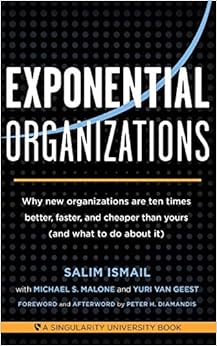
Exponential Organizations: Why new organizations are ten times better, faster, and cheaper than yours (and what to do about it), by Salim Ismail Michael S. Malone

Free Ebook Exponential Organizations: Why new organizations are ten times better, faster, and cheaper than yours (and what to do about it), by Salim Ismail Michael S. Malone
Exponential Organizations: Why New Organizations Are Ten Times Better, Faster, And Cheaper Than Yours (and What To Do About It), By Salim Ismail Michael S. Malone. The established technology, nowadays support every little thing the human demands. It consists of the daily tasks, jobs, workplace, entertainment, as well as much more. Among them is the excellent website connection and computer system. This condition will certainly reduce you to support one of your hobbies, reading practice. So, do you have eager to read this publication Exponential Organizations: Why New Organizations Are Ten Times Better, Faster, And Cheaper Than Yours (and What To Do About It), By Salim Ismail Michael S. Malone now?
This book is really correct for the book style that you are searching for now. Numerous resources may offer the selection, however Exponential Organizations: Why New Organizations Are Ten Times Better, Faster, And Cheaper Than Yours (and What To Do About It), By Salim Ismail Michael S. Malone can be the very best way. It is not only one thing that you can appreciate. A lot more things as well as lessons are supplied or you to cover what you exactly need. Lots of viewers have to read guides likewise because of the specific factors. Some might enjoy to read it so much however some could require it since the task deadline.
Are you actually a follower of this Exponential Organizations: Why New Organizations Are Ten Times Better, Faster, And Cheaper Than Yours (and What To Do About It), By Salim Ismail Michael S. Malone If that's so, why do not you take this book currently? Be the very first individual who such as and also lead this publication Exponential Organizations: Why New Organizations Are Ten Times Better, Faster, And Cheaper Than Yours (and What To Do About It), By Salim Ismail Michael S. Malone, so you can obtain the factor as well as messages from this publication. Don't bother to be perplexed where to obtain it. As the various other, we discuss the connect to visit as well as download the soft file ebook Exponential Organizations: Why New Organizations Are Ten Times Better, Faster, And Cheaper Than Yours (and What To Do About It), By Salim Ismail Michael S. Malone So, you may not lug the published book Exponential Organizations: Why New Organizations Are Ten Times Better, Faster, And Cheaper Than Yours (and What To Do About It), By Salim Ismail Michael S. Malone anywhere.
Get the connect to download this Exponential Organizations: Why New Organizations Are Ten Times Better, Faster, And Cheaper Than Yours (and What To Do About It), By Salim Ismail Michael S. Malone and begin downloading and install. You could want the download soft documents of guide Exponential Organizations: Why New Organizations Are Ten Times Better, Faster, And Cheaper Than Yours (and What To Do About It), By Salim Ismail Michael S. Malone by going through other activities. And that's all done. Currently, your resort to read a publication is not consistently taking and also lugging the book Exponential Organizations: Why New Organizations Are Ten Times Better, Faster, And Cheaper Than Yours (and What To Do About It), By Salim Ismail Michael S. Malone all over you go. You can conserve the soft documents in your gadget that will never be away and also review it as you like. It is like reviewing story tale from your gadget after that. Now, begin to like reading Exponential Organizations: Why New Organizations Are Ten Times Better, Faster, And Cheaper Than Yours (and What To Do About It), By Salim Ismail Michael S. Malone as well as obtain your brand-new life!
Review
"EXPONENTIAL ORGANIZATIONS should be required reading for anyone interested in the ways exponential technologies are reinventing best practices in business.â€â€•Ray Kurzweil, Director of Engineering at Google“EXPONENTIAL ORGANIZATIONS is the most pivotal book in its class. Salim examines the future of organizations and offers readers his insights on the concept of Exponential Organizations, because he himself embodies the strategy, structure, culture, processes, and systems of this new breed of company.â€â€•John Hagel, The Center for the Edge
Read more
About the Author
Salim Ismail is the founding Executive Director at Singularity University, where he moderates most academic programs, and is its current Global Ambassador. Before that, as a vice president at Yahoo, he built and ran Brickhouse, Yahoo’s internal incubator. His most recent company, Angstro, was sold to Google in August 2010. He has founded or operated seven early-stage companies including PubSub Concepts, which laid some of the foundation for the real-time web. He also spent several years as a management consultant with CSC Europe and later with ITIM Associates. Ismail holds a B.Sc. in Theoretical Physics from the University of Waterloo in Canada.
Read more
Product details
Paperback: 326 pages
Publisher: Diversion Books (October 14, 2014)
Language: English
ISBN-10: 1626814236
ISBN-13: 978-1626814233
Product Dimensions:
5 x 0.7 x 8 inches
Shipping Weight: 12.6 ounces (View shipping rates and policies)
Average Customer Review:
4.7 out of 5 stars
307 customer reviews
Amazon Best Sellers Rank:
#21,255 in Books (See Top 100 in Books)
Some cool examples, and cool ideas. Had I read this book in 2014, I would have thought it was revolutionary. However, given that they are writing about the Leading Edge of technology, and it is four years later, it is fun to look at just how right and just how wrong the author was. While I think the guidelines they set for an exponential organization are good, I can't help but feel they are oversimplifying the ability to grow so quickly. Having a process is good. Following this book is probably a good idea. But there's no substitute for having an incredibly unique idea, being incredibly lucky and having Incredible timing all at once.
The term "gazelle" was coined by the economist David Birch. His identification of gazelle companies followed from his 1979 report titled "The Job Generation Process" (MIT Program on Neighborhood and Regional Change), wherein he identified small companies as the biggest creators of new jobs in the economy. In 1994, however, Birch revised his thesis, isolating job-creating companies he called "gazelles." Characterized less by size than by rapid expansion, Birch defined the species as enterprises whose sales doubled every four years. By his estimates, these firms, roughly 4% of all U.S. companies, were responsible for 70% of all new jobs. The gazelles beat out the elephants (like Walmart) and the mice (corner barbershops). When you hear politicians say, "Small businesses create most of the new jobs," they're really talking about young and growing firms. They are talking about gazelles.As Salim Ismail explains in his eponymous book, an exponential organization (ExO) "is one whose impact (or output) is disproportionately large -- at least 10 times larger -- than its peers because of the use of new organizational techniques that leverage accelerating technologies."These are its core values, accompanied by my brief annotations:1. Information Accelerates Everything: But be certain that the information is correct, relevant, and sufficient.2. Drive to Democratization: True, at least in terms of opportunity and access but establish a meritocratic rewards system.3. Disruption Is the New Norm: Again true, but meanwhile, remember that revenue pays the bills4. Beware the "Expert": Wisdom is eternal but expertise must accommodate the work to be done now.6. Smaller Beats Bigger: Unless the subject is profits. I do agree that not all growth is progress.7. Rent, Don't Own: This creates options and alternatives while minimizing fixed, depreciating costs.8. Trust Beats Control and Open Beats Closed: Trust lubricates mutually beneficial collaboration.9. Everything Is Measurable and Anything Is Knowable: That is true more often than not but not absolute.Here are the six characteristics of exponential leadership, accompanied by Ismail's comments:1. Visionary Customer Advocate. "If customers see their needs and desires being attended to at the highest levels, they are much more willing to persevere through the chaos and experimentation that often happens with exponential growth."2. Data-driven Experimentalist: "To create order out of high-speed chaos requires a process-oriented approach that is ultimately nimble and scalable."3. Optimistic Realist: "Leaders able to articulate a positive outcome through any scenario, even downside scenarios, will be able to help maintain objectivity within their teams."4. Extreme Adaptability: "As a business scales and its activities morph, so too must its management...Constant learning is critical to staying on the exponential curve."5. Radical Openness: "While many [most?] leaders and their organizations ignore most of the criticism and suggestions [from within and beyond], creating an open channel to the crowd [outside of the given C-Suite] and the mechanisms to determine signal from noise can provide new perspectives and solutions, allowing access to whole new layers of innovation."6. Hyper-Confident: "Two of the most important personality traits for an exponential leader to have are the courage and perseverance to learn, adapt and ultimately, disrupt the given business."In my opinion, after only a few modifications, these are also the defining characteristics of those who lead small-to-midsize companies as well as those who head divisions, business unites, and even departments in Fortune 100 companies such as those that Ismail examines in Chapter Nine of this book, notably Coca-Cola Company, General Electric, Amazon, Zappos (owned by Amazon), and Google Ventures.As Ismail explains in Chapter Nine, these forward-looking companies "are implementing the ideas discussed in the previous chapter ["ExOs for Large Organizations"]. Some are building ExOs at their edges; some are acquiring or investing in ExOs in their current market space; still others are implementing ExO Lite [see Pages 228-239].Long ago, Ezra Pound urged aspiring writers to "make it new." I was again reminded of that challenge as I noted the reference to "new organizations" in this book's subtitle. Salim Ismail urges business leaders not only to make their organizations new but also to make them "ten times better, faster, and cheaper" than their competition. In fact, I presume to suggest that a company's greatest competitor tomorrow will be who it is, what it does, and how it does it today. With organizations as with individuals, most limits are self-imposed.
I learnt about this book via the Dutch marketing efforts at BNR-radio by the Dutch co-author Juri van Geest (it worked!).Good stuff! What I really like about this book is:- brain metaphor and acronyms for the internal and external focus. People tend to focus on the external and forget it won't work if you got your internal act together (Steve Jobs and Elon Musk knew/know this best I think).- the chapters on the types of organisations, where the exponential characteristics are to be implemented. The downside risk and upside gain differ whether you are a real startup, a midsize company or a large multinational. Startup-enthusiasts tend to forget where they are implementing and put existing stuff at unnecessary risk. So good that they warn you to 'copy-cat' the right way.There is one 'big but' I have on the usage on the usage of term exponential organizations. My objection to the exponential metaphor is that in nature exponential growing stuff is either really bad stuff (diseases such as cancer or ebola) or the end of a bubble (assets in financial markets, ending in a Mynsky Meltup or Meltdown), there are plenty of other examples [armstrongeconomics.com is a fun source for this].This should also make you wonder on exponential organizations. If you know how to ride the wave towards the top you are fine, but the ride down can be lethal or financially unsound (when not on the shorting end).When you disrupt something and grow exponential, bear in mind that something allowed you to do so, but might strike you after all (when catching up). Often referred examples Uber and AirBnB are currently predominantly battling with (local) government in the new places they go, and governments. Saying that it now can't be stopped is foolish. History tells us that governments tend to be bad losers, when (potentially) expected tax is involved. So mind your tail(risk).If you are interested in the subject start-ups you should certainly read book 'Zero to One' of the quoted Peter Thiel. He will share you some 'secrets' to prevent you from attempting to grow before it is good for you.And IMHO people should stopping using 'disruptive' in every sentence. We sort of know that by now... :-)
What is the biggest threat to your organization, right now? Many would answer “our competition.†In the race for sales, customer loyalty, and market share, it’s easy to look over your shoulder at the other lanes and feel like your biggest threats are external.This leads many organizations to ignore a deadly internal threat: resisting disruptive innovation. That hinders them from adopting the attributes needed to achieve exponential growth. The book calls this the corporate “immune system.†Ismail's book shows you how to disable the corporate immune system so that disruptive innovation can take root and grow your company exponentially.
Exponential Organizations: Why new organizations are ten times better, faster, and cheaper than yours (and what to do about it), by Salim Ismail Michael S. Malone PDF
Exponential Organizations: Why new organizations are ten times better, faster, and cheaper than yours (and what to do about it), by Salim Ismail Michael S. Malone EPub
Exponential Organizations: Why new organizations are ten times better, faster, and cheaper than yours (and what to do about it), by Salim Ismail Michael S. Malone Doc
Exponential Organizations: Why new organizations are ten times better, faster, and cheaper than yours (and what to do about it), by Salim Ismail Michael S. Malone iBooks
Exponential Organizations: Why new organizations are ten times better, faster, and cheaper than yours (and what to do about it), by Salim Ismail Michael S. Malone rtf
Exponential Organizations: Why new organizations are ten times better, faster, and cheaper than yours (and what to do about it), by Salim Ismail Michael S. Malone Mobipocket
Exponential Organizations: Why new organizations are ten times better, faster, and cheaper than yours (and what to do about it), by Salim Ismail Michael S. Malone Kindle


0 comments:
Post a Comment